Palais de l’Île: the prison in the middle of the river
Why it is shaped like that
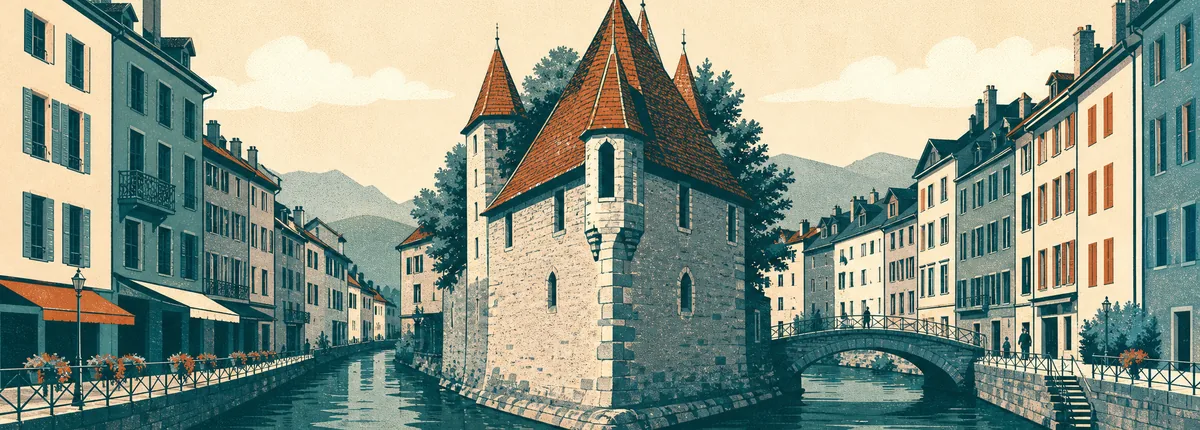
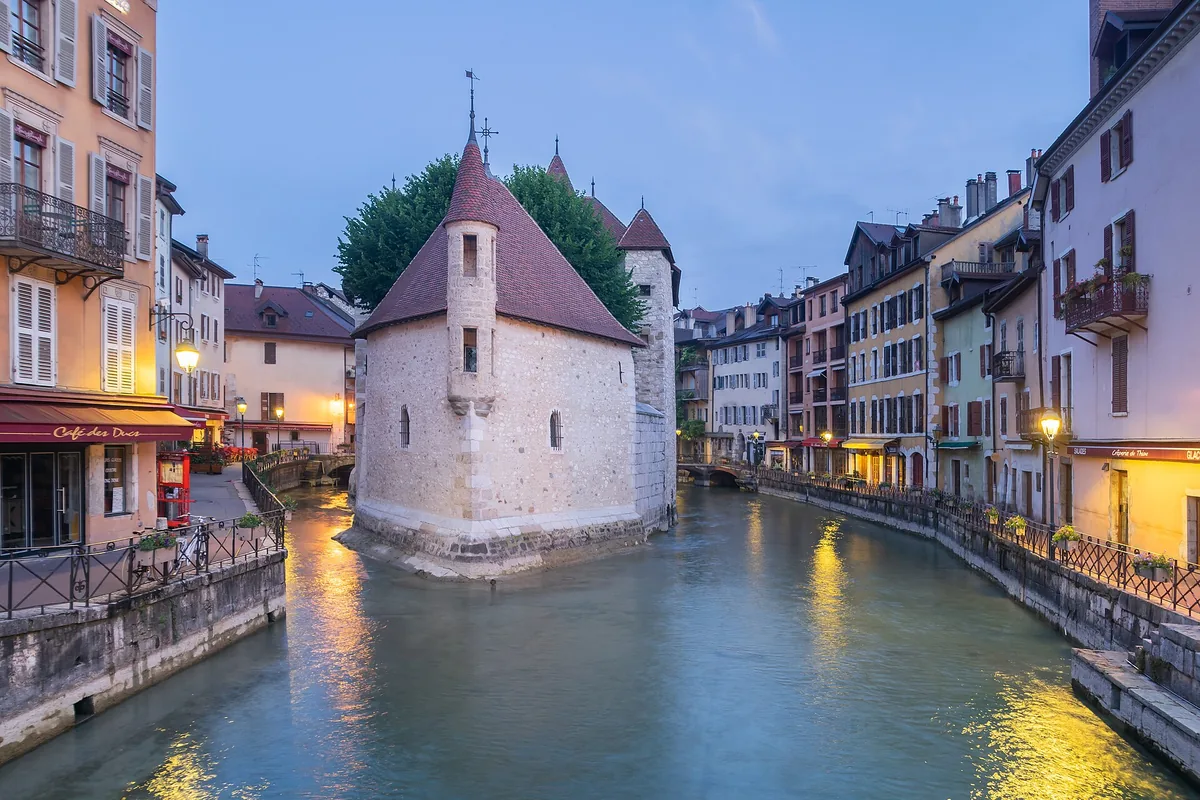
The stock description is “a house in the shape of a ship”, and it is a good description, but the shape is not a design choice. The building sits on a natural rock in the middle of the Thiou, and its walls follow the rock. The prow that points upstream is the shape of the island, worn into that form by the current long before anyone built on it. Everything about the Palais de l’Île follows from that one fact: a defensible rock in a river running through the middle of a town is worth building on, and worth building on repeatedly.
Eight hundred years of changing its mind
The oldest parts of the structure date from the 12th century. Its documented career begins in 1325, when the lord of Annecy paid a man named Jean de Monthoux for the food of two prisoners — which is how we know it was a prison, and a modest one.
In 1355 Count Amadeus III of Geneva was granted the right to mint gold and silver by the Emperor Charles IV, and a minting workshop was built here. It ran until the end of the 14th century. A river island in a fortified town is exactly where you put a mint: one way in, water on every side, and the town’s own walls between you and everyone else.
By the late 16th century it had become the Palais de Justice de l’Isle — the courthouse — and it stayed in administrative and judicial use for centuries afterwards. It went on holding prisoners until 1864, when a new prison opened elsewhere in the town. It was listed as a monument historique in 1900.
The building is more interesting from outside than in, and that is not a criticism. The exterior is eight hundred years of continuous adaptation visible in one silhouette; the interior is a small municipal museum. If you have one ticket to spend in Annecy and you want objects and paintings, spend it up the hill at the château instead.
Going inside
The Palais de l’Île operates as a small museum of local history and architecture, run by the town’s museums service. You walk through the old cells, the courtroom and a set of rooms covering the building’s own story and the development of Annecy around it. It takes most people between thirty and forty-five minutes.
Admission is EUR 4 for adults from January to June and September to December, and EUR 5 in July and August. Children pay EUR 2 and EUR 2.50 for the same periods, and under-12s go free. A combined ticket with the Musée-Château costs around EUR 8 to 9, which is the one to buy if you intend to see both. It is closed on Tuesdays.
Opening hours shift with the season and the museums service publishes the current schedule; check the day you are going rather than trusting a figure on any guide, this one included.
Photographing it
The classic frame is from the Pont Perrière, looking upstream, with the prow splitting the water and the Old Town rising behind. It works because the bridge puts you level with the building and centred on the channel. Two practical notes: it is east-facing, so morning light is on the prow, and the bridge is genuinely crowded from mid-morning until evening in summer. Before nine you will have it alone.
The second-best angle is from the quai de l’Île on the north bank, which gives you the flank of the building and the reflection, and is almost never busy because it is not the shot people arrive expecting to take.
Nearby: the Musée-Château is about 130 m away as the crow flies, up the ramp · the rest of the Old Town
 60 minutes
Annecy: Express Walk with a Local in 60 Minutes
 Self-guided
Annecy: Historical City Game – The Shadow of the Sword
 Private guide
Annecy: Two-Hour Insider Walking Tour with a Local Guide
Frequently asked questions
How much does it cost to go inside the Palais de l'Ile?
Adults pay EUR 4 from January to June and September to December, and EUR 5 in July and August. Children are EUR 2 and EUR 2.50, and under-12s are free. A combined ticket with the Musee-Chateau is around EUR 8 to 9.
Is the Palais de l'Ile worth visiting inside?
It is a modest local-history museum in an extraordinary building. If you are interested in the prison, the mint and the town's own story, yes. If you want art and objects, the Musee-Chateau up the hill gives you more for the money.
Why is the Palais de l'Ile shaped like a boat?
Because it is built on a natural rock in the middle of the Thiou and its walls follow the rock. The pointed prow facing upstream is the shape of the island itself, not a stylistic decision.
Was the Palais de l'Ile really a prison?
Yes, repeatedly. It appears in the record as a prison in 1325, and it went on holding prisoners until 1864, when a new prison opened in the town. In between it was also a mint and the town's courthouse.
What day is the Palais de l'Ile closed?
Tuesdays. Hours otherwise vary by season, so check the museums service's current schedule for the day you are visiting.