Annecy Old Town: what is actually there
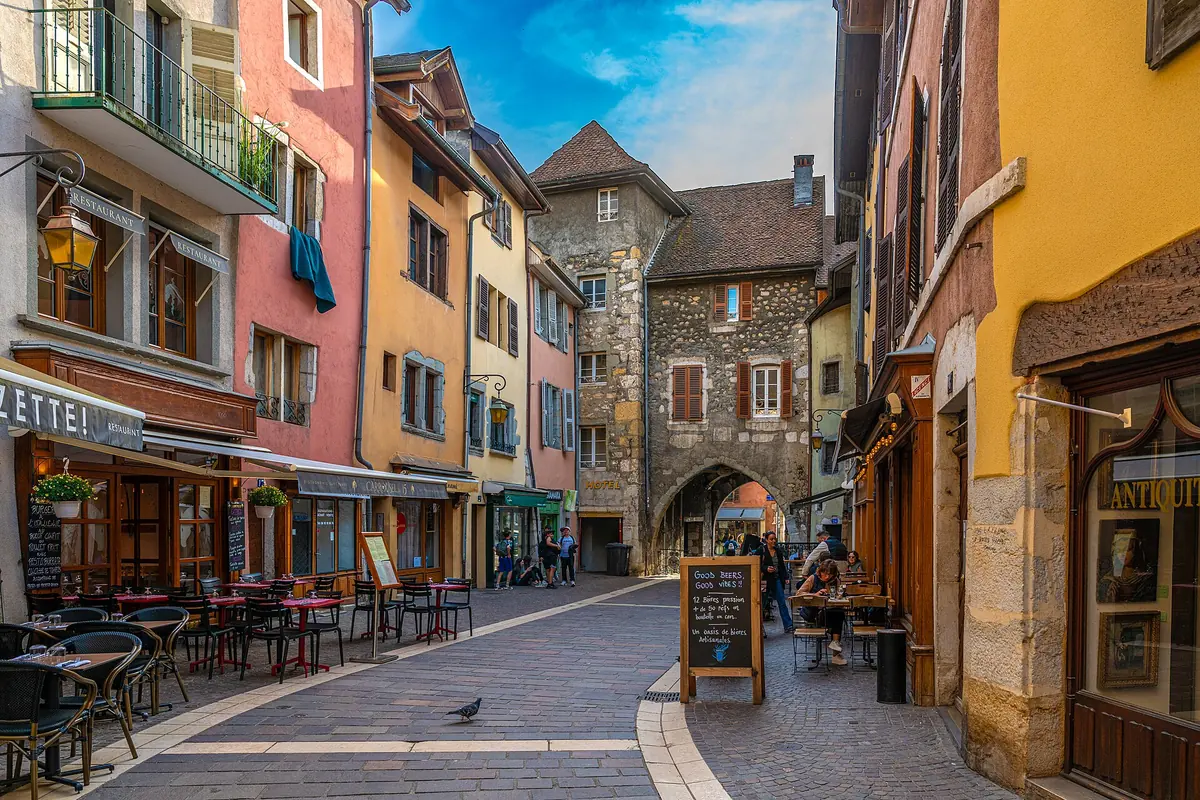
The shape of it
The Old Town is organised by water, not by streets. The Thiou leaves the lake at the northern shore, splits, and runs west through the middle of the historic core before rejoining itself and heading off to the Fier and eventually the Rhône. Everything historic in Annecy is arranged along that watercourse, because for six hundred years the Thiou was the town’s power supply — mills, forges, tanneries and later a paper works all sat on its banks and took their turn at the current.
That is why the Old Town looks the way it does. The buildings crowd the water because the water was the reason to be there. The arcades along the rue Sainte-Claire and the rue Perrière are not decoration either; they are covered market frontage, which is what you build when you want to trade in a place that gets 1,600 mm of rain a year.
What to see, in the order the light works
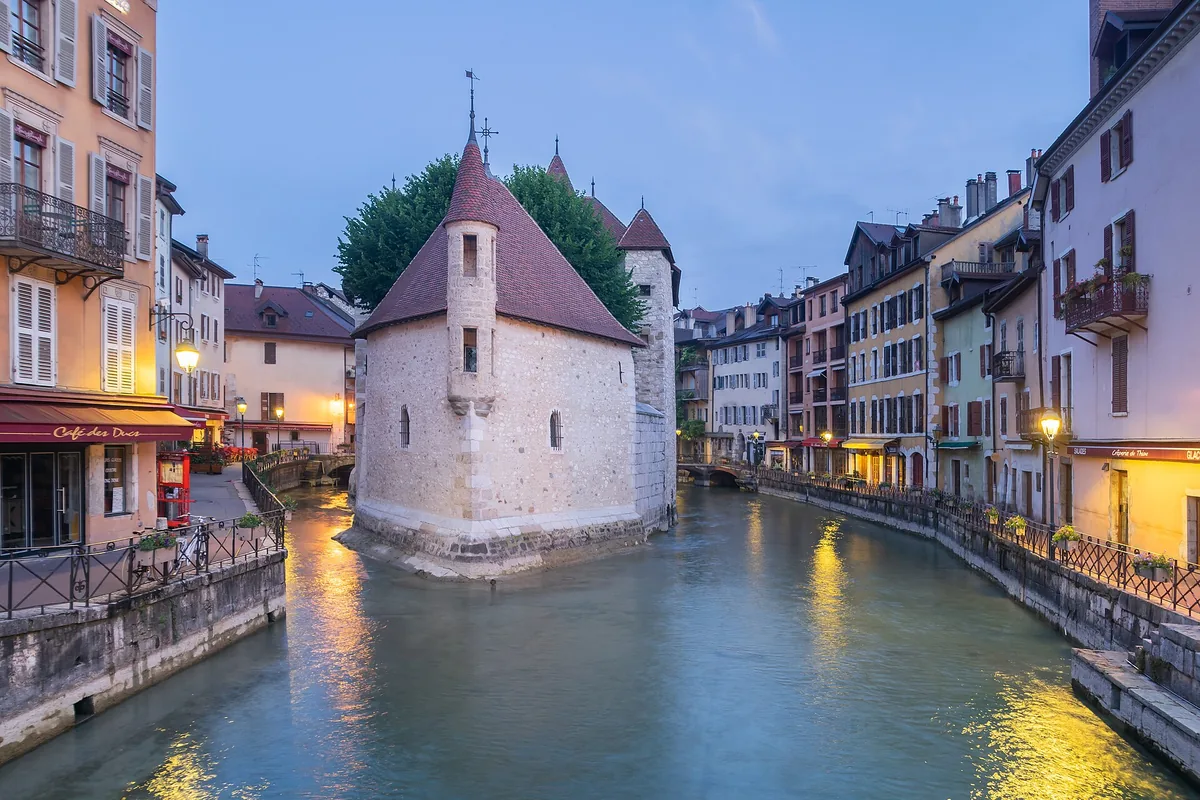
- The Pont Perrière and the Palais de l’Île. The photograph. Get there before nine and you will have the bridge to yourself; by two in the afternoon it is a queue of people waiting for the same frame.
- Rue Sainte-Claire. The long arcaded spine of the Old Town, and the site of the market on Tuesday, Friday and Sunday mornings. It is a working market, not a souvenir one.
- The Thiou quaysides. Walk the quai de l’Île and the quai Perrière on both banks. Ten minutes, and it is the whole town in miniature.
- The ramp up to the château. Steep, cobbled, and short. The courtyard at the top has the best free view in Annecy, and you do not need a museum ticket to stand in it.
- Les Jardins de l’Europe and the Pont des Amours. Where the Old Town meets the lake, across the Vassé canal. The mature trees here were planted when the gardens were laid out in the 19th century on land reclaimed from the lake.
The one genuine mistake visitors make in the Old Town is arriving at midday. The lanes are narrow, the crowd is unidirectional and the light is flat and overhead — the worst of all three conditions at once. The same walk at half past eight is almost empty, the light comes straight down the canal, and the bakeries have just opened.
Is there anything you have to pay for?
Almost nothing. Walking the Old Town, the quaysides, the château ramp, the gardens and the Pont des Amours is free. The two paid attractions are both museums: the Palais de l’Île at EUR 4 for most of the year and EUR 5 in July and August, and the Musée-Château at EUR 6.50 rising to EUR 7.00 from 1 July to 31 August. A combined ticket for both is around EUR 8 to 9 and is worth it if you plan to go inside either.
If you would rather have the context than the interiors, a short guided walk covers the canals, the prison and the mint story in about an hour for less than the price of two museum tickets. It is a nice-to-have rather than a need-to-have; the Old Town is small and signposted and you will not get lost.
 60 minutes
Annecy: Express Walk with a Local in 60 Minutes
 Self-guided
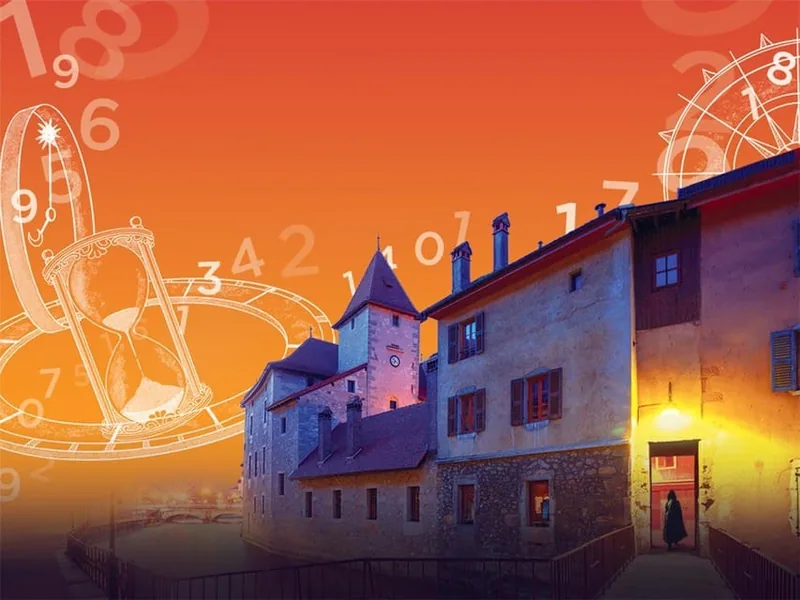
Annecy: Historical City Game – The Shadow of the Sword
 Private guide
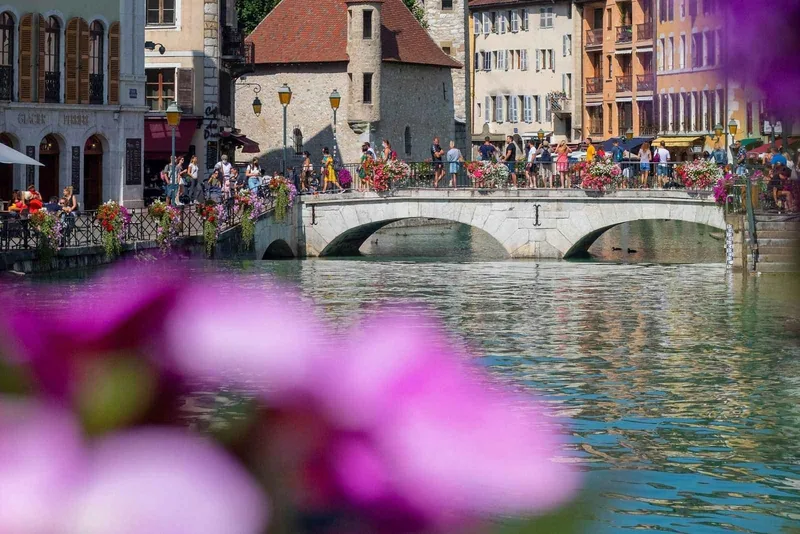
Annecy: Two-Hour Insider Walking Tour with a Local Guide
Why there is so little medieval church here
Visitors who know other alpine towns notice something missing: for a place with a 12th century core, Annecy is short on grand medieval religious architecture. The reason is that the town’s religious importance arrived later than its buildings. Annecy became the seat of the displaced bishops of Geneva in the 16th century, which made it a centre of the Counter-Reformation rather than a medieval cathedral city. What survives in the centre is civic, commercial and defensive — the mint, the courthouse, the market arcades, the castle — because those are the things a trading town on a river actually built.
Practicalities
What works
- Entirely pedestrianised — no traffic to negotiate anywhere in the core
- Compact enough to cover properly in a morning, with no transport needed
- Free to walk, and the best viewpoint (the chateau courtyard) costs nothing
- Market three mornings a week on rue Sainte-Claire, and it is a real one
- Every canal-side restaurant terrace has the same view, so you can pick on menu alone
Worth knowing
- Cobbles throughout — awkward with wheeled luggage, prams and some mobility aids
- Solidly crowded between about 11:00 and 18:00 from June to August
- The nearest car parks fill by mid-morning in summer; do not drive in
- Canal-side terraces charge canal-side prices, and the view is free from the bridge
- Very few public toilets in the core itself — the lakefront has more
Next: the Old Town mapped, street by street · the Palais de l’Île in full · the Musée-Château · everything else
Frequently asked questions
How long does it take to walk around Annecy Old Town?
About an hour at a walking pace, or a whole morning if you stop. The historic core is roughly half a kilometre across and pedestrianised throughout, so distance is never the constraint — the crowds are.
Is Annecy Old Town free to visit?
Yes. The streets, the canals, the quaysides, the chateau ramp and the Jardins de l'Europe are all free. Only the two museums charge: the Palais de l'Ile and the Musee-Chateau, at EUR 4 to 5 and EUR 6.50 to 7.00 respectively.
When is the market in Annecy Old Town?
Tuesday, Friday and Sunday mornings along the rue Sainte-Claire and the surrounding lanes. It is a working food market rather than a souvenir one, and Sunday is the biggest.
Can you drive into Annecy Old Town?
No. The historic core is pedestrianised. Park at Bonlieu (693 spaces) or Hotel de Ville (432 spaces) at EUR 1.10 an hour and walk in — both are a few minutes away. Note the 1.95 m height limit at Parking Courier if you are in a van or a roof-boxed car.
What is the best time of day to photograph Annecy?
Before about nine in the morning. The lanes are empty, the light runs straight down the Thiou and the reflections are still. The Pont Perriere at nine and the Pont Perriere at two are completely different experiences.